


Where we live plays a powerful role in shaping economic, health, and educational outcomes. Access to strong schools, reliable transit, jobs, and health resources can influence long-term stability for residents and open pathways to upward mobility. Research suggests that when young children move from high-poverty to low-poverty neighborhoods, their total lifetime earnings increase by about $302,000.
Neighborhoods even influence how many jobs families can easily reach, the caliber of schools available to their children, the level of environmental risks they face, the accessibility of social services, and much more. Access to these resources makes neighborhoods an important consideration to help low-income families become more upwardly mobile.
In the fourth edition of our Housing Impact Report blog series, we share how you can use the Neighborhood Opportunity Search Tool to unlock opportunity in your community.
Unlocking opportunity
The Public and Affordable Housing Research Corporation (PAHRC), HAI Group's research division, created the Neighborhood Opportunity Search Tool to help affordable housing providers increase affordability in areas of opportunity and expand resources in areas previously cut off from investment.
This tool provides a suite of maps that help housing providers, service providers, residents, policymakers, researchers, and community leaders assess each neighborhood’s potential for economic mobility and healthy living.
It includes data on affordable rental properties and educational opportunities, job access, health outlook, transit access, desirability, and neighborhood change for each neighborhood relative to their greater metropolitan area:
 |
 |
 |
 |
| Opportunity Capital | Health Outlook | Educational Opportunity | Labor Market Access |
 |
 |
 |
 |
| Transit Access | Neighborhood Desirability | Neighborhood Desirability Trajectory | Investment Pathway |
Housing providers can use these tools to:
- Inform your organization’s affordable housing investment strategy
- Counsel Housing Choice Voucher holders on which neighborhoods meet their family’s needs
- Collect data to inform grant applications
- Inform affordable housing preservation plans
- Conduct research on neighborhood opportunity, desirability, and change
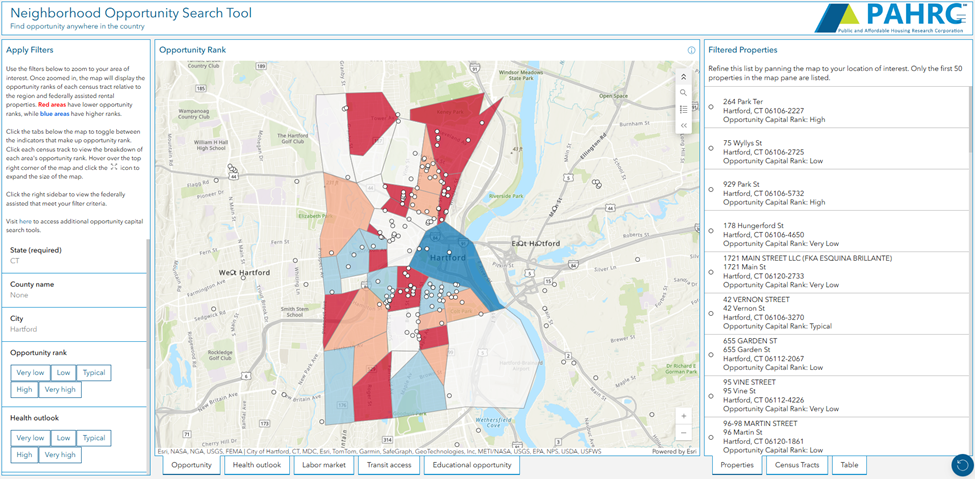
Neighborhood Opportunity Search Tool filtered to Hartford, CT
Each map can be filtered by state, county, and city to quantify each area’s potential for economic mobility and healthy living. From there, you can identify federally assisted properties located in neighborhoods that provide access to transit, health outlook, connection to the labor market, and educational opportunities for residents. This can inform your preservation, acquisition, counseling, partnership, and re-investment strategies.
Takeaways for housing providers
Affordable housing can be found in all types of neighborhoods
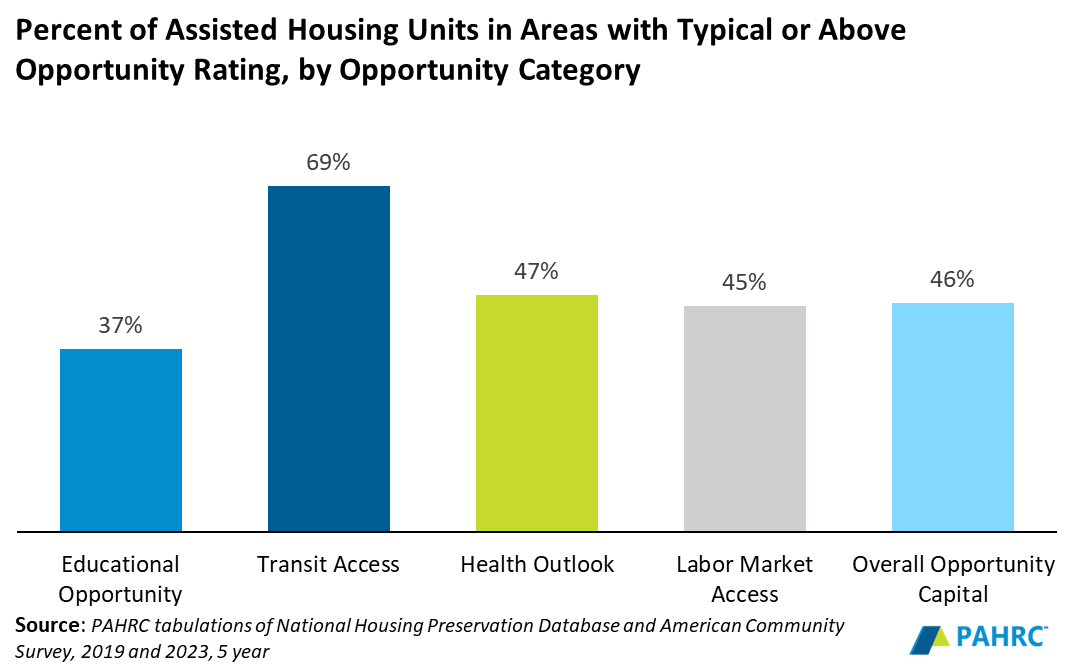
Nearly every metro area and congressional district, and 96% of counties, have affordable rental homes. Affordable rental housing is in neighborhoods that offer a range of educational opportunities, transit access, health care, and labor-market access. Overall, 46% of federally assisted rental homes are in neighborhoods ranking typical or better in opportunity relative to their region. Given these patterns, continuing to invest in federal housing assistance programs and the neighborhoods they serve could significantly improve opportunities for upward mobility.
There are numerous pathways to invest in the sustainability of communities
Based on trends in opportunity, neighborhood quality, and neighborhood trajectory, we identified five affordable housing-led neighborhood investment strategies to improve affordability and residents' quality of life.
|
Pathway |
Classification |
Description |
|
Focus on Bargains |
Typical or Better Opportunity Below Typical Desirability |
Properties in these areas may be well-priced, enabling the expansion of affordable housing options. Residents in these areas would benefit from greater access to opportunity, and there would be less difficulty in ‘penciling out’ the cost of development. |
|
Focus on Entry |
Typical or Better Opportunity Typical or Better Desirability |
These neighborhoods may currently have little assisted housing and may be on the verge of becoming more affordable. |
|
Focus on Revitalization |
Below Typical Opportunity Below Typical Desirability |
These neighborhoods could benefit from a comprehensive redevelopment plan and partnerships with health, education, transit, and employment providers to bring opportunities to these areas. |
|
Focus on Tipping Points |
Typical or Better Opportunity Below Typical Desirability |
These neighborhoods may be at a ‘tipping point’ and in danger of losing ground in opportunity. Strengthening partnerships and continuing to invest in housing rehabilitation and preservation could be key activities to help such neighborhoods maintain their level of opportunity. |
|
Focus on Preservation |
Typical or Better Opportunity Typical or Better Desirability |
These neighborhoods may be hard to reach for affordable housing, as they may have higher rents and rates of affordable housing opt-outs. Keeping assisted units affordable in these neighborhoods might focus on building relationships with landlords to improve landlord retention and increase participation. |
Interested in locating federally assisted rental properties that meet each of these investment pathways in your area? Visit our Investment Pathway Search Tool.
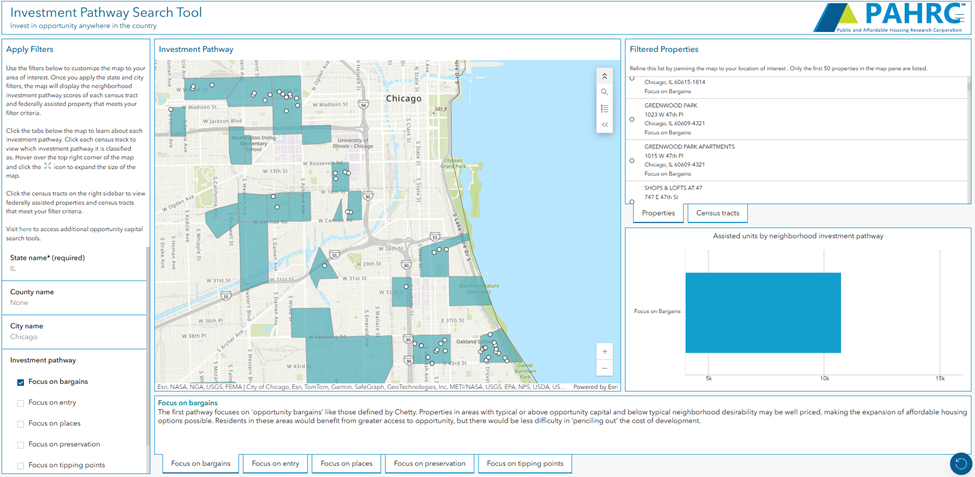
Investment Pathway Search Tool filtered to display affordable properties in Chicago classified as having a ‘focus on bargains’ investment pathway.
Neighborhood characteristics can inform preservation risk assessments
Properties assisted by the Low Income Housing Tax Credit (LIHTC) program located in tighter rental markets or more desirable neighborhoods are at greater risk for rent increases following the expiration of affordability restrictions. On the flip side, LIHTC properties in weaker housing markets may have difficulty generating sufficient rental income to finance continued maintenance and rehabilitation.
Data from the Neighborhood Opportunity Search Tool can be used to inform preservation strategies, like Montgomery County’s preservation study, which examined median rent, household income, building age, rail transit access, ownership type, and income-targeting level to inform planning efforts.
Ready to learn more?
Download the Housing Impact Report for more data to dispel myths and demonstrate the impact of affordable housing.

Download the Neighborhood Opportunity Search Tool Methodology to learn more about how the data in this tool was compiled.