
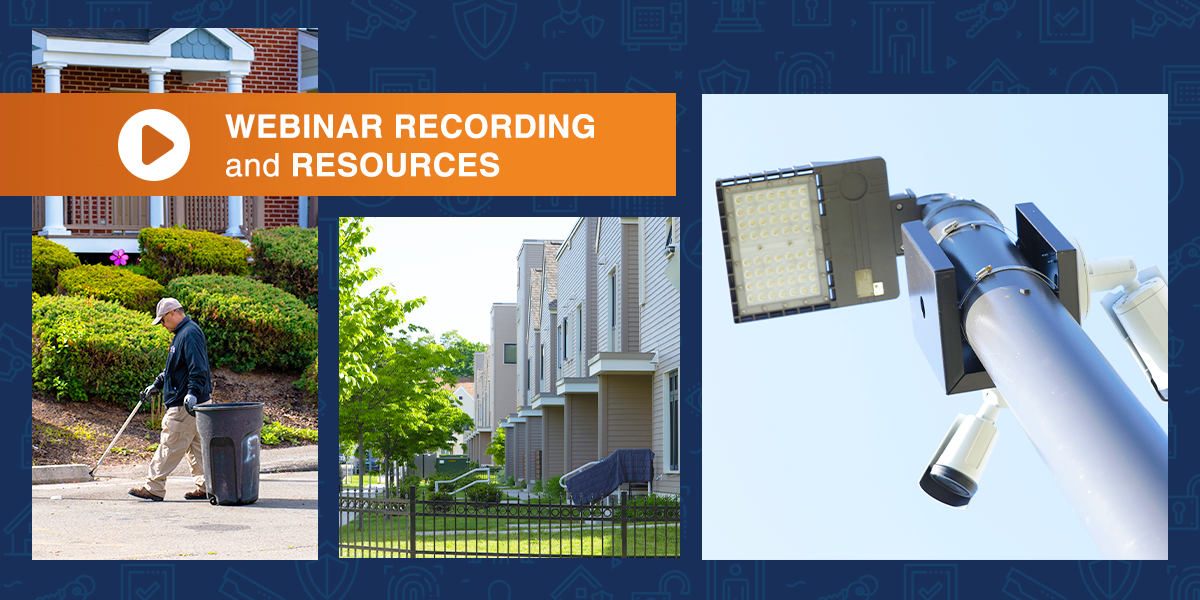

Crime prevention starts long before an incident occurs. For housing organizations, safety is shaped by how properties are designed, maintained, monitored, and used day to day. Lighting, landscaping, entry points, community spaces, resident engagement, and routine maintenance can all influence how people move through a property and how safe they feel while doing so.
To help housing professionals apply these concepts in real-world settings, HAI Group hosted Designing Safer Communities: CPTED Principles for Housing Professionals, a virtual event featuring Art Hushen, founder of the National Institute of Crime Prevention.
Watch the full recorded session to learn how Crime Prevention Through Environmental Design (CPTED) principles can help housing organizations evaluate their properties, identify security gaps, and strengthen safety through practical, site-specific strategies.
What is CPTED?
CPTED is an approach to safety that uses design, maintenance, and property operations to reduce opportunities for crime and support positive use of a space. During the session, Hushen explained that CPTED is not limited to cameras, locks, or fencing; CPTED also examines how the built environment functions as a whole, including how residents, visitors, staff, and others experience and navigate the property.
Core CPTED concepts include natural surveillance, natural access control, territorial reinforcement, and maintenance. The session also covered related considerations, including traffic calming, landscaping, transition zones, lighting, wayfinding, pedestrian scale, activity generators, and community engagement.
Why CPTED matters for multifamily housing
Multifamily housing communities have unique safety considerations. Residents, guests, staff, vendors, and service providers may all access the property at different times and for different reasons. That makes it important for housing organizations to understand how people enter, move through, and use shared spaces.
The session emphasized that CPTED can help housing professionals think more intentionally about:
- How entry and exit points are defined and monitored
- Whether lighting supports visibility and safety
- How landscaping affects sightlines
- Whether signage and wayfinding help direct visitors
- How common areas, walkways, parking lots, and building entrances are used
- How maintenance issues may create safety concerns
- How resident communication and engagement support crime prevention
Hushen also discussed how CPTED principles can help organizations evaluate risk before an incident occurs, rather than reacting after a problem has already escalated.
CPTED is more than security equipment
One key takeaway from the event was that CPTED should not be treated as a checklist of security equipment. Cameras, lighting, locks, and access control can all play important roles, but they are most effective when they are part of a broader strategy. For example, Hushen addressed camera placement at points of entry and exit, lighting in parking lots and common areas, deadbolts, window locks, pool gate access, and door viewers.
Hushen also encouraged attendees to consider the following questions behind those tools:
-
Where are people entering and exiting?
-
Are there informal cut-through paths?
-
Are cameras supported by proper lighting?
-
Are signs clear?
-
Are residents reporting concerns?
-
Are maintenance plans addressing issues before they create larger risks?
For housing professionals, the goal is not just to add more equipment—it's to understand how each safety measure supports the overall use and management of the property.
Lighting deserves careful attention
Lighting is one of the most visible CPTED considerations, but Hushen emphasized that effective lighting is about more than brightness. Housing organizations should evaluate whether lighting provides adequate visibility in key areas, including parking lots, walkways, laundry rooms, common areas, entrances, and other shared spaces.
A stronger lighting strategy also considers fixture placement, consistency, color temperature, and how well lighting supports cameras and other security measures. In some cases, adding more light may not solve the problem if fixtures are poorly placed, create glare, or leave uneven coverage across the property.
Resident engagement is part of the safety strategy
CPTED is also connected to how residents and staff understand and participate in community safety. The session highlighted crime deterrence and safety training topics, including crime prevention basics, CPTED, the benefits of knowing residents, key control, ongoing security management, maintenance, crime prevention applications, resident safety flyers, newsletters, social media, and resident workshops.
Those practices help create a stronger safety culture. When residents know how to report concerns, staff understand what to look for, and management communicates regularly about safety issues, housing organizations are better positioned to identify and respond to emerging risks.
Questions from the session
What should housing organizations look for when hiring someone to conduct a CPTED assessment?
Hushen recommended looking for someone with the right experience and training to conduct a full assessment, not just a basic security review. A qualified assessor should understand CPTED principles, lighting, perimeter protection, documentation, and how recommendations may affect the property.
He also noted that vague recommendations, such as adding more lighting without explaining what is needed or why, can create confusion and unnecessary cost. Housing organizations should look for professionals who can provide site-specific, practical guidance.
Should vacant buildings be evaluated differently?
Many of the same CPTED practices still apply to vacant buildings, especially if the property may be occupied again in the future. Evaluating a vacant property can give organizations an opportunity to identify and address issues before residents move in.
Vacant buildings may also make it easier to review doors, windows, access points, and other physical security features. The key is to use the opportunity to plan ahead rather than waiting until occupancy resumes.
How does maintenance support CPTED?
A well-maintained property can support safety by improving visibility, reinforcing clear boundaries, and showing that shared spaces are actively cared for. Overgrown landscaping, poor lighting, damaged signs, broken locks, and unclear pathways can all affect how residents, staff, and visitors experience a property.
The presentation noted that many security and safety issues may be addressed through a property maintenance plan. That makes routine maintenance one of the most practical ways housing organizations can support safer communities.
Why is documentation important?
Documentation helps show that an organization is paying attention to safety conditions, resident concerns, crime trends, and property needs. Hushen discussed the importance of reviewing crime data, documenting resident concerns, and understanding how foreseeable risks may affect property operations.
At the same time, organizations should be thoughtful about when and how formal assessments are documented. Before starting a documented assessment, it is important to understand what may need to be corrected and how the organization will respond.
Continue exploring CPTED and property safety
CPTED gives housing professionals a practical framework for evaluating how design, maintenance, technology, and operations work together to support safer communities. To learn more, watch the full recording of Designing Safer Communities: CPTED Principles for Housing Professionals.
For additional guidance, visit the HAI Group Resource Center for articles, videos, and risk management resources designed for public and affordable housing organizations.

To learn more about CPTED and available support, reach out to your HAI Group risk control consultant.