

Resident behavior can play a significant role in property losses, liability claims, and life safety incidents. While policies, inspections, and enforcement are important parts of risk control, communication can help housing organizations address risks before incidents occur.
During the eighth annual HAI Group Virtual Risk Management Conference, Director of Risk Control and Consulting Elizabeth Owens explored how strategic communication can influence resident behavior and help create safer communities.
From understanding resident needs and choosing effective communication channels to delivering clear safety messages and encouraging lasting behavior change, Owens shared practical strategies housing organizations can put into action. Attendee poll results also revealed how organizations currently communicate with residents, gather feedback, and navigate common challenges, offering additional insight into opportunities to strengthen resident engagement.
Watch the full session recording below to hear Owens' recommendations and learn how to strengthen resident communication at your organization.
Resident communication is part of risk control
 Residents are active participants in an organization’s risk profile every day. Cooking fires, careless smoking, overloaded electrical circuits, unreported spills, cluttered hallways, and disabled smoke alarms are just a few examples of risks that can be influenced by resident behavior.
Communication alone cannot eliminate these risks, but ongoing education can help residents understand what is expected of them and why those expectations matter. Owens emphasized that behavior change happens over time and through repetition. If cooking fires are a concern, for example, an organization might distribute a flyer, play a cooking-safety video in common areas, and discuss the topic at a resident meeting.
The goal is not to communicate about every risk at once. Focusing on one or two priorities and reinforcing them consistently can make messages easier to understand and remember. As Owens explained during the session, consistency beats intensity.
Build the culture before delivering the message
Effective resident communication starts with an organization’s internal risk culture. Staff members are often residents’ primary point of contact, making them some of an organization’s most visible risk communicators. When staff members model safe practices and consistently enforce policies, their actions reinforce the messages residents receive.
The opposite is also true. A notice reminding residents that grills are prohibited on balconies will have limited impact if the policy is not consistently enforced. Housing organizations can begin building this culture during staff onboarding and resident lease-up, then reinforce expectations through training, resident meetings, safety events, and other ongoing communication.
The connection between education and action matters. Resident-facing materials are most effective when leadership supports the message and staff members consistently model and reinforce the expected behavior.
Know who you are communicating with
Residents usually don't fit into a single audience. A housing organization may serve seniors, families, working adults, and people with different languages, abilities, and communication preferences. That makes audience segmentation an important part of an effective communication strategy.
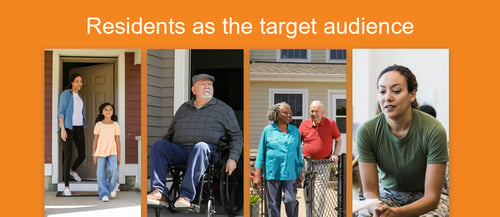 During the conference, attendees were asked whether they segment residents in their communication. Of 127 respondents, 48% said they do so sometimes, while only 21% said they do so consistently. Another 16% said rarely and 15% said not at all.
Those results highlight an opportunity to make resident communication more targeted. A message that works for a family living in a townhome may not be as effective for a senior living in a high-rise. Organizations can also use existing information to better understand their audiences, including communication preferences, common questions, recurring concerns, and language or accessibility needs.
Listen to what residents are telling you
Understanding residents doesn't necessarily require a complex research process. Annual surveys, recertification meetings, new resident orientations, resident councils, service requests, and conversations with staff can all provide useful insights into where communication gaps exist.
Conference attendees reported using several of these approaches. When asked how they currently gather resident insights, the most common response was informal feedback, selected by 39% of poll respondents. Surveys followed at 30%, staff observations at 22%, and 9% do not currently gather resident insights.
Informal feedback can be valuable, but Owens encouraged organizations to document what they hear so information shared with one staff member is not lost. Tracking recurring feedback can help organizations identify patterns and determine where additional education may be needed. Existing operational information can also help. Reviewing common service requests, lease violations, incidents, and loss trends can provide a starting point for deciding which safety topics deserve greater attention.
Use more than one communication channel
There is no single communication method that will reach every resident. Owens recommended a multi-touchpoint approach that could include newsletters, recertification appointments, posters, door hangers, videos in common areas, in-unit materials, resident meetings, and training events.
The conference poll results illustrate why a mix matters. Among the respondents, 45% said residents engage most with printed materials such as posters and door hangers. Another 25% selected in-person interactions, while 16% chose digital communication such as email, text, and video. The remaining 14% were not sure which channel generated the most engagement.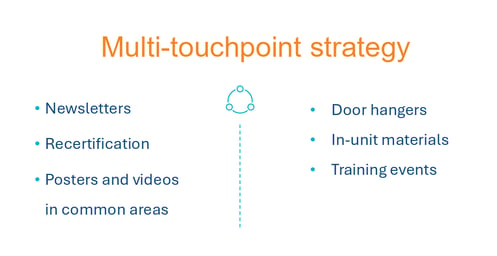
Rather than choosing between print, digital, and in-person communication, organizations can use these channels together to reinforce the same message. A resident who sees a safety message on a poster, hears about it during a meeting, and encounters it again on a common-area television has multiple opportunities to absorb and remember the information.
Organizations should also pay attention to what works. If incidents decrease or residents demonstrate a better understanding of a policy, the communication strategy may be having an impact. If confusion or unsafe behaviors continue, it may be time to adjust the message, format, frequency, or channel.
Make safety messages specific and actionable
Clear communication tells residents what action to take. Instead of a broad message such as “Practice safe cooking,” Owens recommended giving residents a specific action, such as “Never leave cooking unattended.”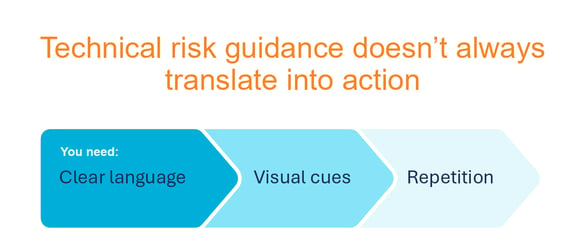
The difference is important. General safety language can leave room for interpretation, while a focused call to action clearly communicates the expected behavior. Visuals can also help messages stand out and make information easier to understand across language and literacy barriers. Combined with repetition and consistent follow-through, clear language and visual communication can help important safety information stick.
Reduce the burden on staff
Knowing what to communicate is only part of the challenge. Finding the time and resources to do it consistently can be difficult. When conference attendees were asked about their biggest barrier to consistent communication, 38% selected time. Strategy and approach followed at 28%, resources at 23%, and content or materials at 10%.
During the session, an attendee asked about tools available to support resident communication and whether HAI Group helps cover their costs. The HAI Group Resource Center offers publicly available safety videos, risk guides, tip sheets, articles, and other educational content to support risk management efforts. HAI Group members also have access to the Member Resources Storefront, featuring ready-to-use resident safety materials, including door hangers, magnets, tip cards, posters, and more. Contact your HAI Group risk control consultant to learn more about the storefront and available materials.
Beyond these resources, Owens also encouraged organizations to explore communication platforms that allow them to segment audiences and deliver targeted messages. Options such as mass communication tools and private social media groups can help organizations reach residents more effectively, depending on their needs and preferences.
You can access the full resident resources playlist on our YouTube channel.
Turn communication into safer behavior
Effective resident communication is not about sending more information. It is about delivering the right information, in a format residents can understand, and reinforcing it often enough to encourage action:
-
Start with the risks affecting your properties.
-
Learn how residents prefer to receive information.
-
Focus on one or two clear actions.
-
Use multiple communication channels.
Then measure whether the message is making a difference. Most importantly, make sure the communication residents receive matches what they see from staff.
When education, policies, inspections, and enforcement reinforce one another, residents can become active participants in an organization’s risk management culture.
Catch up on the Virtual Risk Management Conference
Owens' presentation was the first of four sessions held during the 2026 Virtual Risk Management Conference. Watch this session and the other conference presentations on the Virtual Risk Management Conference playlist.
For additional guidance on strengthening resident communication and reducing risks at your properties, contact your HAI Group Risk Control Consultant.
