---
title: Your Guide to the Housing Impact Report’s Most Important Insights to Dispel Affordable Housing Myths
description: Key trends from PAHRC’s Housing Impact Report on who affordable housing serves, growing need, and how programs support communities.
image: https://blog.haigroup.com/hubfs/PAHRC_Research/2026_Housing_Impact_Report/Blog%20Featured%20Images/Blog1_KeyTrendsinAffordableHousing.png
---
[Skip to content](https://blog.haigroup.com/your-guide-to-the-housing-impact-reports-most-important-insights-to-dispel-affordable-housing-myths#main-content)
[](https://www.haigroup.com/)
- SEARCH
- [Research](https://blog.haigroup.com/tag/research)
# Your Guide to the Housing Impact Report’s Most Important Insights to Dispel Affordable Housing Myths
- April 8, 2026

[Kelly McElwain, Director, Research, Public and Affordable Housing Research Corporation (PAHRC)](https://blog.haigroup.com/author/kellly-mcelwain-pahrc)
[\< Back to Resource Center](https://blog.haigroup.com)
If you’re an affordable housing provider, knowing current facts about who needs and uses affordable housing is essential. This knowledge informs your advocacy and helps you tailor programs for your community’s evolving needs.
The Housing Impact Report, developed by the Public and Affordable Housing Research Corporation, HAI Group’s research division, delivers a comprehensive, data-driven look at how affordable rental homes shape the lives of individuals, families, and neighborhoods.
PAHRC’s new [Housing Impact Report, "How Affordable Homes Strengthen People and Communities,"](http://www.pahrc.org/research) provides clear evidence to counter widespread affordable housing misconceptions and to showcase these programs’ measurable impact.
In the first edition of this blog series, we share the key trends examined in this report to help you understand demographic shifts in who is served by affordable housing programs, the number of households in need, and how long households wait to receive assistance.
Access the full report to see how housing providers support residents and how affordable housing benefits the broader community.
[](https://blog.haigroup.com/hs/cta/wi/redirect?encryptedPayload=AVxigLJb2RA3sMk5PL17ROU%2BLQdQAV8%2B%2FZchFlj2UJyoGqMCk7ZfEeWrO%2FZOnrLY021c5HVHZm30UG8y1low6Jxm2BgZnIbAyd91XP3r8yIa%2BDGEIOveInjqNyutZIvFCBZ2LU9G7APFWH4xYmD3zipcPdsm%2Fj4xC2wl6lGwsLU0dxgF4cSlFpx3nZEy6bluG9jszLDzmx8%3D&webInteractiveContentId=210284909826&portalId=20790879)
## Who do affordable housing programs support?
**Affordable housing programs help 6.62 million households avoid homelessness and poverty. These include** 2.66 million with older adults, 2.18 million with a member with a disability, and 2.11 million with children.
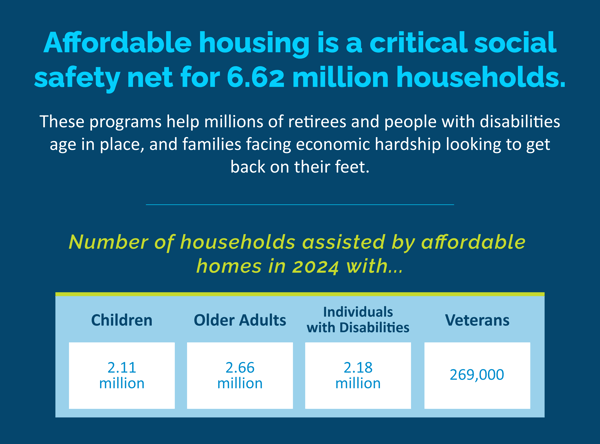
*PAHRC. (2026). Housing Impact Report.*
**Affordable housing is crucial for families on fixed incomes.** Older adults and people with disabilities, often on fixed incomes, make up a large share of residents. Forty-seven percent of these households include an older adult or a person with a disability.
**These programs also help communities keep essential workers.** Most people living in affordable homes who can work are working. In 2024, 86% of assisted households with a working-age, non-disabled member were currently or recently working. Of these, 76% worked in March 2024, up from 70% in March 2015. Over the full year, 84% worked at some point, compared to 81% in 2015.
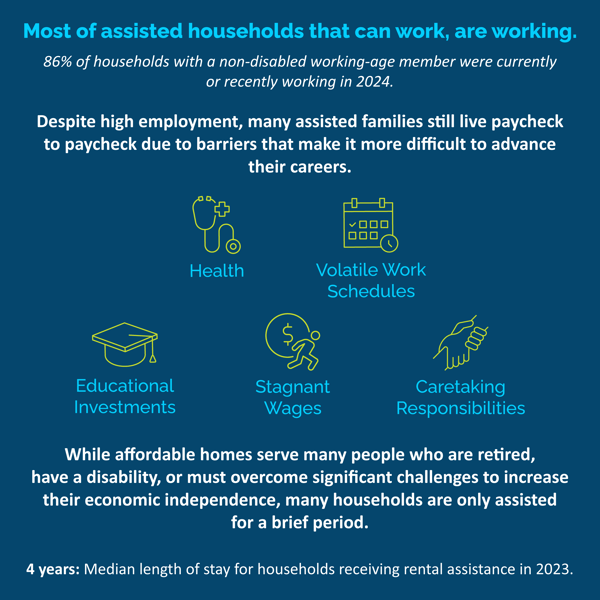
*PAHRC. (2026). Housing Impact Report.*
##### To learn about who is served in your state, access PAHRC’s [Housing Impact Report Dashboard](https://public.tableau.com/app/profile/cateasp/viz/HousingImpactReportDashboard/USHIR).
[](https://blog.haigroup.com/hs/cta/wi/redirect?encryptedPayload=AVxigLL8mhug339h8aKeYfmnAKoWUA%2BsfsT226LTbWLyqTgkXSYfmidp23p3CXBFT5Qi5E1RZYVOmixIRNCuQUa7qzB7HBPOJtVd4RkNr2VM70Ut23bAV8kbnDkvqFzUa1wsuOGpDPzON9EUSkBsiC1hNrpSvmsygTe25BGXNeugr80aaAaWrUlUL9dwzMUM7W0e0J4EVdn7HPdNdVAjX6s%2BcE%2BzV0GneHKuA1DrRU14l1baaNDPPgeDXwYgvINfSgH%2BDcyX9mCSfkGFv7A%3D&webInteractiveContentId=210655479870&portalId=20790879)
[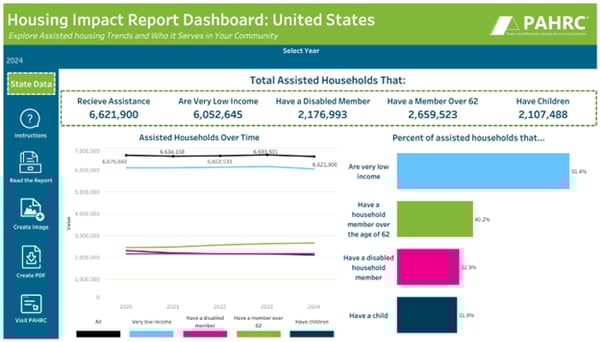](https://public.tableau.com/app/profile/cateasp/viz/HousingImpactReportDashboard/USHIR)PAHRC Housing Impact Report Dashboard.
## How have households supported by these programs changed over time?
Affordable housing programs are increasingly supporting households with the greatest needs.
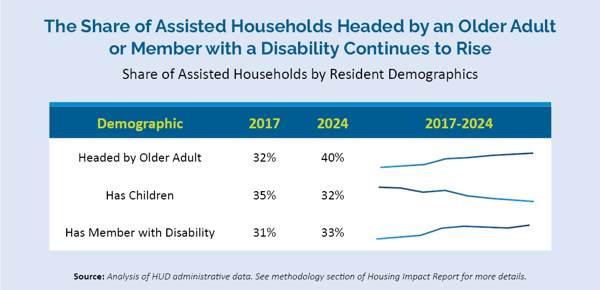
**Older adults and people with disabilities make up a growing number and share of assisted households.** Between 2017 and 2024, the number of assisted households with older adults increased by 20%, while the number of households with a member with a disability increased by 2%. The share of assisted households headed by an older adult increased dramatically from 32% in 2017 to 40% in 2024.
**As a result of these shifts, the share of assisted households with a member likely able to work has steadily decreased over the last decade.** In 2024, only 41% of assisted households included a member likely able to work, down from 27% in 2015. The number and share of assisted households with children have also decreased.
**Over the past decade, the share of households earning extremely low incomes has risen.** In 2024, 78% of households receiving rental assistance earned less than 30% of the area median income, up from 73% in 2014.
## How many households need assistance?
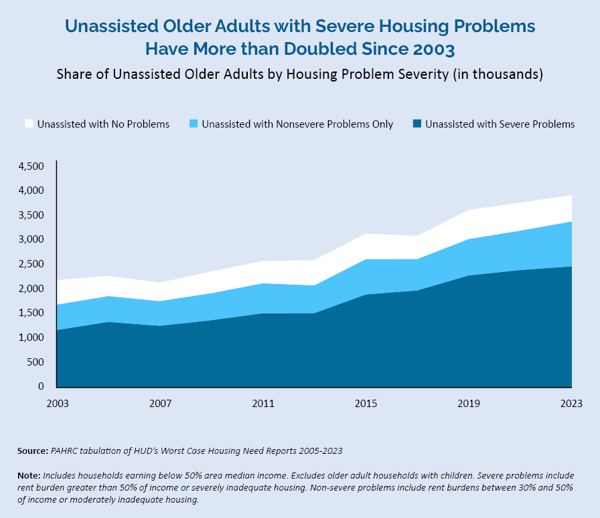
**The need for affordable housing far exceeds supply.** Only one in four very low-income renters receives assistance, leaving 13.77 million without help. Among these households, 8.46 million had severe housing problems, such as paying over half their income for rent or living in unsafe or crowded homes. Between 2003 and 2023, very low-income unassisted renters rose by 21%, while those with severe housing problems rose by 64%.
**More older adults are receiving help, but the need is growing faster.** In 2023, 3.91 million very low-income households led by an older adult likely qualified for assistance but did not receive it. That’s up from 2.14 million in 2003. Of these, 2.46 million had severe housing problems, more than double since 2003.
**As a result, waiting times for affordable housing are long.** The average household waits 17 months for assistance.
## How long do households receive assistance?
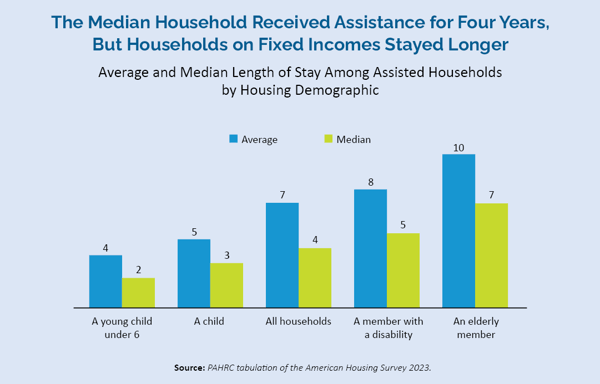
**Half of households receiving rental assistance stay for just four years**, although the length of stay varies, with households including older adults and peoplewith disabilities remaining longer.
## Ready to learn more?
[Download the Housing Impact Report](http://www.pahrc.org/research) for more data to dispel myths and demonstrate the impact of affordable housing.
## Additional resources
- [Housing Research: How Affordable Homes Strengthen People and Communities](https://blog.haigroup.com/housing-research-how-affordable-homes-strengthen-people-and-communities)
- [The Transformative Impact of Revitalizing Public Housing](https://blog.haigroup.com/the-transformative-impact-of-revitalizing-public-housing)
- [Myth vs. Reality: Data-Driven Insights on Affordable Housing](https://blog.haigroup.com/myth-vs.-reality-data-driven-insights-on-affordable-housing)
The information presented is for general reference only. HAI Group makes no representation or warranty about the accuracy or applicability of this information for any particular use or circumstance. Your use of this information is at your own discretion and risk. HAI Group and any author or contributor identified herein assume no responsibility for your use of this information. You should consult with your legal, professional or subject matter advisor before implementing any new strategy or policy.
HAI Group® is the registered trademark of Housing Authority Risk Retention Group, Inc. and its related companies. For a complete list of HAI Group companies, visit www.haigroup.com. Products or services may not be available in all jurisdictions. Certain property and casualty coverage may be provided by a risk retention group or a surplus lines insurer or by a third party. Risk retention groups and surplus lines insurers do not participate in state guaranty funds and their insureds are not protected by such funds.
Don't Miss This
## Related Content
[](https://blog.haigroup.com/housing-research-10-year-roadmap-for-public-housing-sustainability-technical-report)
- April 8, 2026
### [Housing Research: 10 Year Roadmap for Public Housing Sustainability Technical Report](https://blog.haigroup.com/housing-research-10-year-roadmap-for-public-housing-sustainability-technical-report)
October 23, 2025
Maintaining safe, affordable homes for residents has become increasingly urgent as public housing ages. These homes...
[Read more](https://blog.haigroup.com/housing-research-10-year-roadmap-for-public-housing-sustainability-technical-report)
[](https://blog.haigroup.com/housing-research-how-affordable-homes-strengthen-people-and-communities)
- April 8, 2026
### [Housing Research: How Affordable Homes Strengthen People and Communities](https://blog.haigroup.com/housing-research-how-affordable-homes-strengthen-people-and-communities)
April 8, 2026
Affordable housing plays a critical role in supporting residents and strengthening communities nationwide. As housing...
[Read more](https://blog.haigroup.com/housing-research-how-affordable-homes-strengthen-people-and-communities)
[](https://blog.haigroup.com/spotlight-on-pahrc-in-affordable-housing-news-for-public-housing-preservation-research)
- April 8, 2026
### [Spotlight on PAHRC in Affordable Housing News for Public Housing Preservation Research](https://blog.haigroup.com/spotlight-on-pahrc-in-affordable-housing-news-for-public-housing-preservation-research)
January 8, 2026
The Public and Affordable Housing Research Corporation (PAHRC), HAI Group’s research division, was recently featured in...
[Read more](https://blog.haigroup.com/spotlight-on-pahrc-in-affordable-housing-news-for-public-housing-preservation-research)

- [Online Privacy Policy](https://www.haigroup.com/privacy-policy/)
- [California Privacy Rights](https://www.haigroup.com/wp-content/uploads/2024/11/HAI-Group-CA-Privacy-Rights-Notice-1.pdf)
- [Terms of Use](https://www.haigroup.com/terms-of-use/)
```json
{
"@context" : "https://schema.org",
"@type" : "BlogPosting",
"author" : {
"@type" : "Person",
"name" : "Kelly McElwain, Director, Research, Public and Affordable Housing Research Corporation (PAHRC)",
"url" : "https://blog.haigroup.com/author/kellly-mcelwain-pahrc"
},
"dateModified" : "2026-05-04T20:01:29.492Z",
"datePublished" : "2026-04-08T12:00:00.000Z",
"headline" : "Your Guide to the Housing Impact Report’s Most Important Insights to Dispel Affordable Housing Myths",
"image" : [ "https://blog.haigroup.com/hubfs/PAHRC_Research/2026_Housing_Impact_Report/Blog%20Featured%20Images/Blog1_KeyTrendsinAffordableHousing.png" ],
"mainEntityOfPage" : {
"@id" : "https://blog.haigroup.com/your-guide-to-the-housing-impact-reports-most-important-insights-to-dispel-affordable-housing-myths",
"@type" : "WebPage"
},
"publisher" : {
"@type" : "Organization",
"logo" : {
"@type" : "ImageObject",
"url" : "https://blog.haigroup.com/hubfs/HAIGroup%20PMS2186C%20400X100-300dpi-1.png"
},
"name" : "HARRG"
}
}
```