

The multifamily rental market is getting bigger. Over the past decade, the rental stock grew by 5.5 million units, rising to 45.6 million rental units nationwide.
The affordable housing market represents a significant subset of this market, which included 5.1 million units in 2025. In this article, we define affordable housing, explain how it works, and summarize the opportunities for developers, brokers, lenders, and agents to grow with this market.
What is affordable housing?
A home is considered affordable if a household pays less than 30% of its income on housing. Because incomes vary, the rent considered affordable differs from one household to another.
To help build and maintain affordable housing, the government offers property owners tax credits, grants, low-interest mortgages, or rental subsidies if they keep rents affordable for low-income families. There are dozens of affordable housing programs that have their own rules for determining who qualifies and the conditions property owners must meet. Affordable housing often depends on funding from multiple programs to ensure the cost of developing and operating the property pencils out.
Early on, affordable housing was mostly built and owned by the government. In the 1930s, the government began funding housing authorities to build public housing. By the 1980s, construction of new public housing had substantially slowed.
Beginning in the 1960s, new programs were created that incentivized for-profit companies and nonprofit organizations to build and operate affordable housing using a public-private partnership model. Today, most affordable housing is built and preserved this way.
The Low Income Housing Tax Credit (LIHTC) is the biggest program responsible for building new affordable housing. Since it started in 1986, LIHTC has funded 3.7 million affordable homes. Some of these units received multiple rounds of funding. Of those, 2.68 million are currently affordable today.
LIHTC is also the most common tool for preserving existing affordable housing. Increasingly, many public housing authorities (PHAs) are recapitalizing their public housing stock by acquiring tax credits and repositioning these properties using the Rental Assistance Demonstration program.
Additionally, some properties have lower operating margins, allowing them to remain affordable without government help. These are called naturally occurring affordable housing (NOAH), which commonly include accessory dwelling units (ADUs), tiny homes, and older apartments in weaker housing markets. However, they are becoming less prevalent as operating costs rise.
How does affordable housing differ from public housing?
Affordable housing programs have different rules, funding, award criteria, ownership structures, and histories. This can impact who lives in these properties, where they are located, and how they are built. Several differences emerge when comparing public housing to affordable housing funded by tax credits.
Different resident populations
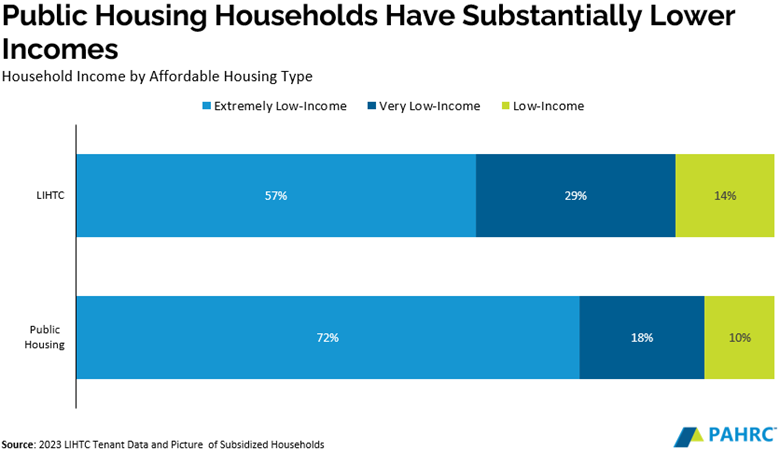
Due to differences in income-targeting requirements, public housing properties tend to serve families with lower incomes and greater needs. Public housing properties more commonly support children, members with disabilities, and those earning extremely low incomes.
Public housing residents pay 30% of their income towards rent. Meanwhile, LIHTC households generally pay rent that is affordable to families earning below 50% or 60% of the area median income.
Affordable housing has greater geographic Dispersion
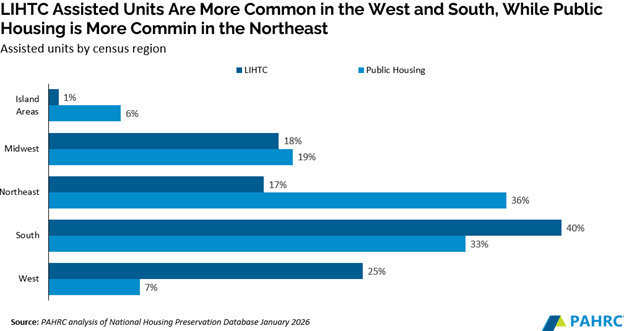
Affordable housing is more common in the West and South, while public housing is more prevalent in the Northeast. A quarter of LIHTC-assisted units are in the West, and 40% are in the South.
Affordable housing is also spread out across more cities. Only 49 metro areas have 2,500 or more public housing units, but 140 have 2,500 LIHTC units.
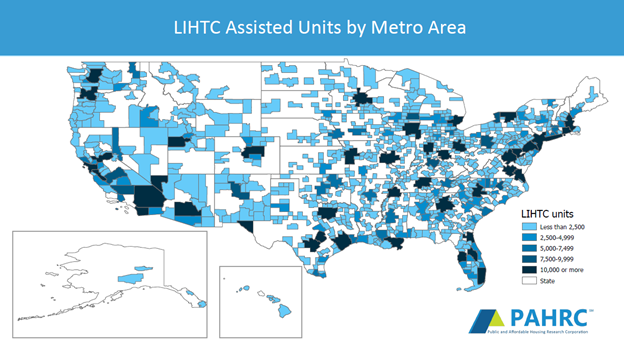
New York has the most public and affordable housing units. Other top metro areas for affordable housing are Los Angeles, Washington, D.C., and Houston. For public housing, the biggest cities are mostly in the Northeast and Midwest, such as Chicago, Boston, and Philadelphia.
| Metro Areas with the 10 Largest Public and Affordable Housing Stocks | |||||
| Public Housing | LIHTC | ||||
| Metro Area | Units | Rank | Units | Rank | |
|
New York-Northern New Jersey-Long Island, NY-NJ-PA |
178,160 |
1 |
172,676 |
1 |
|
|
Los Angeles-Long Beach-Santa Ana, CA |
9,373 |
8 |
74,663 |
2 |
|
|
Washington-Arlington-Alexandria, DC-VA-MD-WV |
10,432 |
7 |
68,115 |
3 |
|
|
Houston-Sugar Land-Baytown, TX |
3,548 |
36 |
58,017 |
4 |
|
|
Dallas-Fort Worth-Arlington, TX |
4,720 |
26 |
56,911 |
5 |
|
|
Atlanta-Sandy Springs-Marietta, GA |
7,510 |
16 |
54,805 |
6 |
|
|
Seattle-Tacoma-Bellevue, WA |
8,632 |
9 |
52,021 |
7 |
|
|
Miami-Fort Lauderdale-Pompano Beach, FL |
8,476 |
11 |
51,790 |
8 |
|
|
Chicago-Joliet-Naperville, IL-IN-WI |
20,667 |
2 |
50,953 |
9 |
|
|
San Francisco-Oakland-Fremont, CA |
4,030 |
29 |
46,378 |
10 |
|
|
Boston-Cambridge-Quincy, MA-NH |
20,171 |
3 |
38,457 |
11 |
|
|
Philadelphia-Camden-Wilmington, PA-NJ-DE-MD |
17,918 |
4 |
34,774 |
12 |
|
|
St. Louis, MO-IL |
8,581 |
10 |
21,525 |
27 |
|
|
Providence-New Bedford-Fall River, RI-MA |
13,216 |
5 |
13,808 |
37 |
|
|
Pittsburgh, PA |
12,699 |
6 |
8,926 |
47 |
|
Affordable housing is much newer
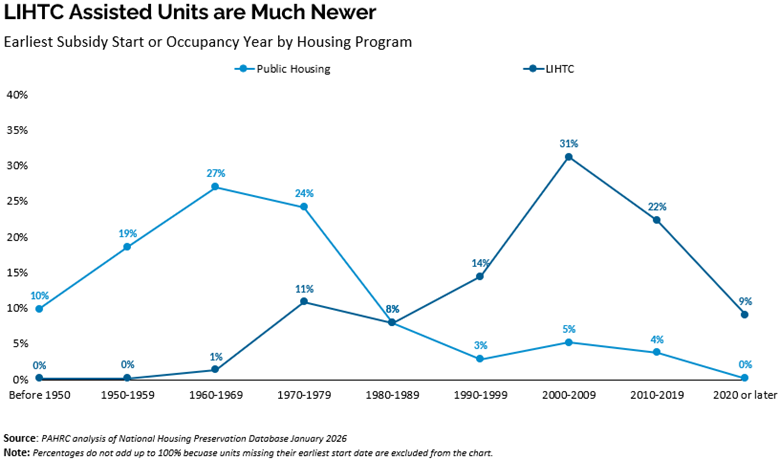
Affordable housing properties are often newer. While four-in-five public housing units were initially funded before 1980, 63% of LIHTC-assisted units were brought online in 2000 or later. Nearly one-third of LIHTC-assisted units were built or recapitalized in the last 15 years.
How does affordable housing work?
Key partners
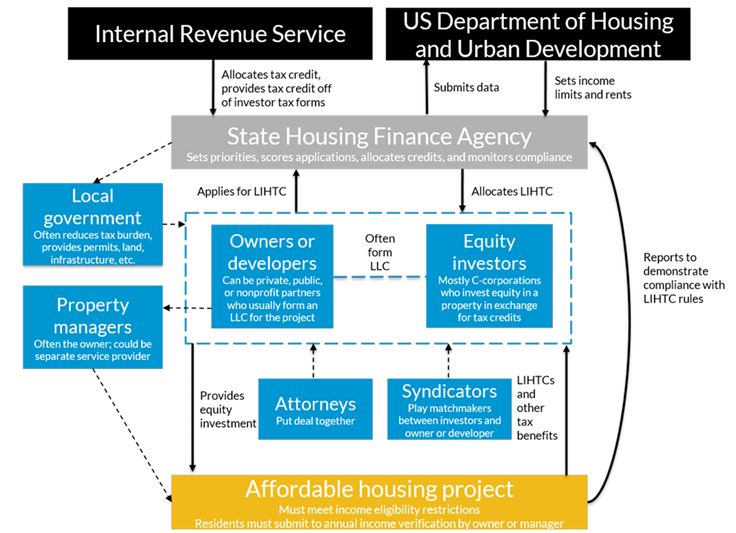
Affordable housing funded by LIHTC includes several players. The Internal Revenue Service allocates tax credits to State Housing Finance Agencies (HFAs), which set local rules for awarding them. Owners and developers apply for these credits, and HFAs decide who gets them based on several criteria, including where the property will be built, how it will be designed, and who it will be targeted to.
Affordable housing developers also apply for funding from other sources, such as lenders and local funds, to fill any funding gaps. Each of these lenders and funders can impose additional requirements that influence how the property is developed.
Once a tax credit is awarded, the affordable housing owner or developer often sells it to an equity investor and forms a Limited Liability Company (LLC). Since affordable housing owners generally do not have sufficient income to claim the tax credit, equity investors provide up-front capital to the developer to fund construction of the property in exchange for an ownership stake and the ability to claim the tax credit over the next 10 years.
Once the property is built, the state HFA monitors the property for compliance with state and federal rules.
Urban Institute. (2018). LIHTC: How it Works and Who it Serves.
Funding
There are two types of tax credits in the LIHTC program:
-
9% tax credits are competitively awarded and can cover up to 70% of development costs.
-
4% tax credits are awarded on a rolling basis but only cover 30% of development costs.
Since tax credits cover only a portion of development costs, these properties often receive supplemental funding from other programs. For instance, Private activity bonds are commonly awarded to fill the financing gap for properties funded by 4% tax credits.
Common requirements
Affordable housing must meet requirements imposed by the federal government, its funders, equity investors, and local communities.
As of 2022, 32 states consider climate hazards when awarding their tax credits, including water conservation, wildfire protection, flood mitigation, and storm protection. Standards vary across states, ranging from limiting development in flood zones to requiring property owners to install fire-retardant window coverings.
Lenders may also require extensive coverage, often including builders' risk, commercial general liability, umbrella liability, boiler and machinery, automobile, and other coverages, depending on the property's location and unique risks.
Developers and property owners are recommended to contact their insurance provider as soon as they have an idea for the project to ensure the insurance requirements are tailored to their property’s needs.
The opportunity to grow with affordable housing
The growth, funding, and partnership model in the affordable multifamily rental housing market makes it an appealing segment for developers, lenders, brokers, and other stakeholders to enter. Research demonstrates that these properties maintain high quality, occupancy rates, and financial solvency, making growing with this market a strong choice.
The affordable housing stock is growing
As the need for affordable housing reaches a near-all-time high, state and local governments are increasingly funding and requiring more affordable housing to be developed. States and cities issued a record $17.2 billion in multifamily private activity bonds to build and preserve affordable properties in 2020, up $2.4 billion from 2010. Additionally, 800 state and local housing trust funds provide $3 billion annually to support affordable housing development.
As a result, Yardi Matrix estimates that 78,000 new affordable units were completed in 2025, which is up 12.6% from 2024. Since 2010, 843,546 affordable housing units have been built or recapitalized through the LIHTC program. Approximately 244,000 of these units were funded in the past few years.
This growth is expected to continue. The One Big Beautiful Bill Act (OBBBA) included several provisions that are projected to support the creation of 1.2 million affordable rental homes over the next decade.
Most affordable housing is high quality
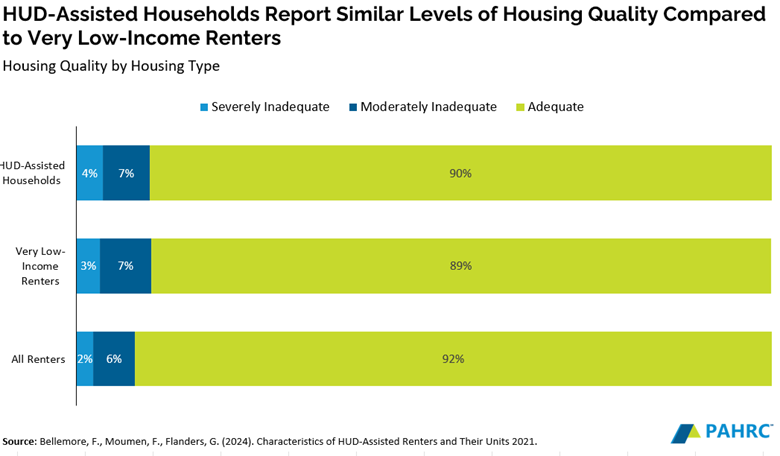
Most affordable housing is in good condition and offers quality comparable to that of regular rental units.
An analysis of the American Housing Survey reveals that nearly 90% of HUD-assisted households live in homes that meet adequate standards, closely matching the 89.2% rate for all very low-income renters. HUD enforces strict safety and quality requirements, mandating regular inspections to ensure properties remain well-maintained.
High occupancy rates
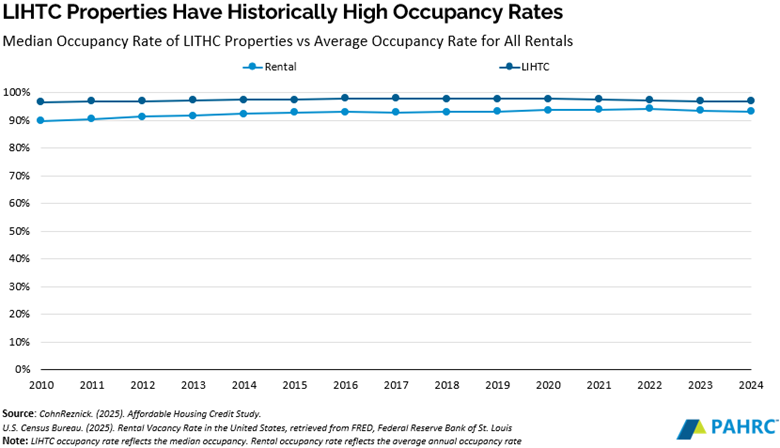
Affordable housing funded by LIHTC maintains historically high occupancy rates. In 2024, the median LIHTC property maintained a 97% occupancy rate throughout the year, a rate that has remained high since 2010. During the same period, the overall occupancy rate of the rental stock was much lower, measuring at 92.9% in the first quarter of 2025.
LIHTC properties have an exceptionally low foreclosure rate
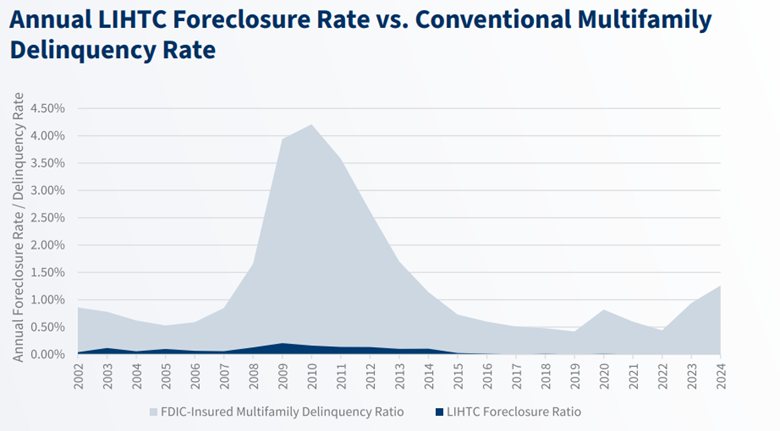
Since the inception of the LIHTC program, properties have reported a cumulative foreclosure rate of just 0.47%, which is substantially lower than the delinquency rate of conventional multifamily rental housing.
CohnReznick. (2025). 2025 Affordable Housing Credit Study.
Why does the LIHTC program have such a successful track record?
Overall, a Novogradac study concluded that the LIHTC program has a strong track record, typically outperforming other affordable housing subsidy programs.
This remarkable stability of LIHTC properties results from consistent demand for affordable housing, oversight by investors and housing finance agencies, and tools to address performance challenges early.
LIHTC properties receive significant funding from institutional investors due to the program's public-private partnership model. Since these tax credits can be reclaimed by the IRS if the property is out of compliance, investors typically screen properties extensively before development and monitor them after construction, generally beyond what state housing finance agencies require. If a property is in financial trouble, investors generally step in to help it before it reaches foreclosure, to protect their investment.
Additionally, state housing finance agencies establish selection criteria and monitor tax credit properties for compliance after construction. States establish these requirements annually in their Qualified Allocation Plan, which allows them to respond to local housing needs or challenges.
How to get started
If you want to grow with the multifamily affordable housing industry, understanding the market is key.
Assess the market
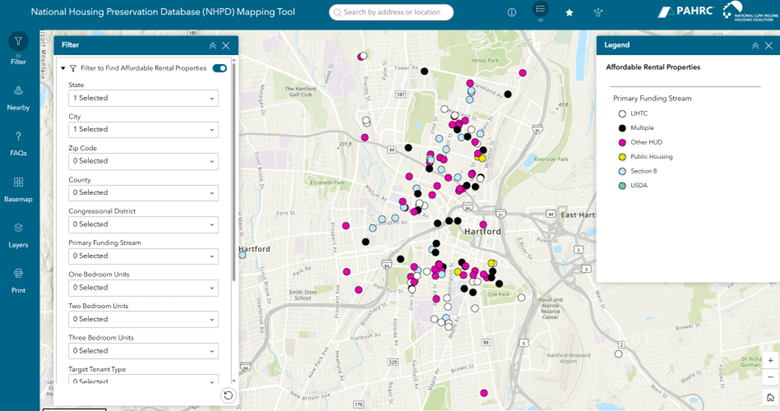
The National Housing Preservation Database (NHPD) can help housing stakeholders locate and quantify affordable housing in target markets, identify acquisition and preservation opportunities, and assess funding characteristics to understand a property’s history and which regulations apply.
Learn the market
Building and financing housing is complex. Developers must create numerous partnerships, overcome challenges, and meet numerous requirements to make their vision a reality.
Obtaining a LIHTC certification, attending training, and staying up to date with the latest research can help developers, agents, brokers, and lenders understand and overcome the complex challenges the market presents, enabling them to remain competitive and provide the best level of service.
Collaborate with vendors that know the market
Collaborating with vendors that specialize in this market can further set your organization up for success. This can include leading developers, managers, insurance providers, and consultants who specialize in this market.
Agents: Interested in working with HAI Group to secure insurance policies for your clients? Contact our Business Development team or click the button below to request a quote.